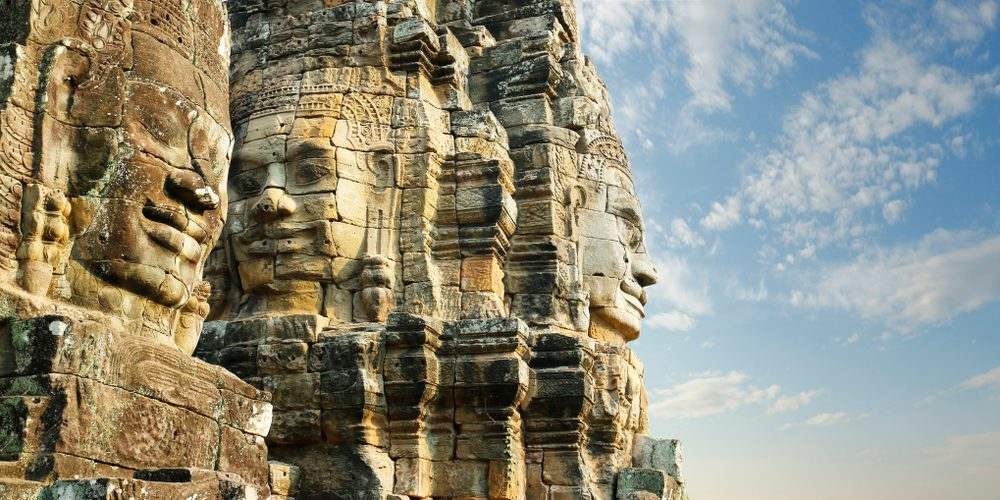
Culture runs deep in Cambodia, and so does the landscape around it: empty beaches, powerful rivers, forest that few people ever walk into. The temples of Angkor lift straight out of that jungle, and they draw in nearly every traveller who comes.
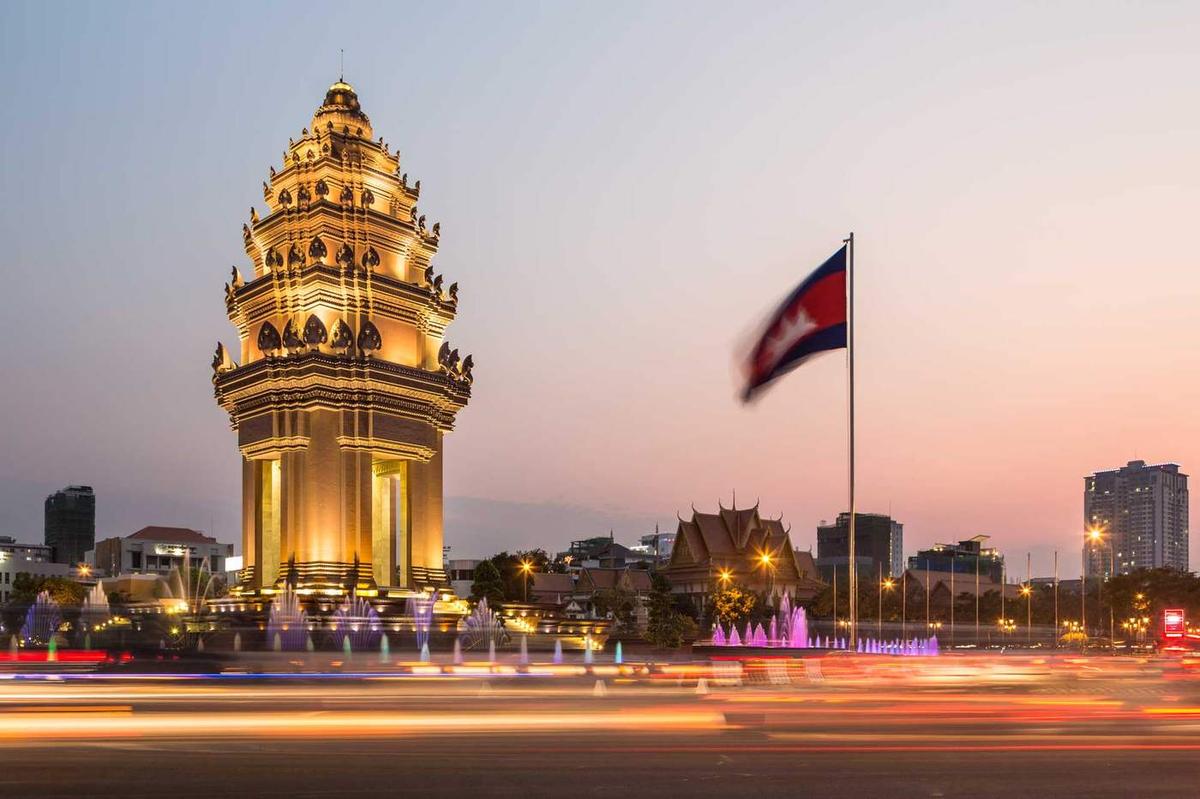
The largest and best known of them is Angkor Wat, yet a week can disappear among the hundreds of other structures nearby. Phnom Penh usually loses the argument with glamorous Angkor, which is a shame. The capital runs on contrast, elegant colonial facades standing next to ramshackle street frontage. Further out, hardly anyone makes time for the hill tribes near Banlung in Ratanakiri province, or the untouched country around sleepy Sen Monorom in Mondolkiri, or Battambang, a riverside town whose faded colonial buildings are still standing. Anyone after nothing more demanding than sand and a slow pace heads for Sihanoukville. Road by road the network keeps improving, and with it opens a delightful country that rewards travellers willing to look past the temple circuit.
Funan held territory across what is now southern Vietnam and the south of Cambodia, and it lasted six centuries. Out of its decline rose the powerful Angkor Empire, which would in time shape the Khmer Kingdom we recognise now.
TIMELINE
First Century AD
A state known as Funan is founded
600AD
Funan fades and the Angkor Empire takes hold
1431
Invaders sack Angkor and leave it in ruin
1970
General Lon Nol, with American backing, removes Cambodia's Head of State
1979
Vietnamese-backed forces of the People's Republic of Kampuchea free the capital
1980s
With Vietnamese help, Cambodia rebuilds its economy
1989
Vietnamese troops pull out and the country is renamed the 'State of Cambodia.'
The Angkorian kings who followed ruled for 650 years, and their empire took in much of Southeast Asia, reaching Burma in one direction and the South China Sea in another, then north as far as southern China. Through that long peak they raised the most elaborate temples, or prasats, ever built, scattering them across the whole kingdom; the best known of all is Angkor Wat. Their engineers matched the builders, laying out sophisticated irrigation networks, vast reservoirs and canal systems that carried food across the empire. Parts of that waterworks still function.
Angkor served as the seat of government, education, worship and trade for a very large kingdom. Then, in 1431, the balance tipped. Invaders came, the city was sacked, and the greatest thing the region had ever built was wrecked. Its people and its wealth drained away, and tropical forest closed over what remained. The court moved south to Long Vek, on to Ou Dong, and finally to Phnom Penh. Hinduism weakened as the old capital died, shifted, and was displaced altogether by Theravada Buddhism, which took its place as the national faith.
As the war in Vietnam widened, Cambodian border areas were struck repeatedly by American and Vietnamese forces. On 18 March 1970 General Lon Nol, with American support, deposed the country's leader, and Cambodia was pulled fully into the fighting, largely against the Khmer Rouge. His grip lasted barely five years: on 17 April 1975 the Khmer Rouge under Pol Pot took power. The pattern of 1431 repeated itself. Phnom Penh was emptied by force and left to decay. What followed was a reign of terror over the whole population, with people driven into the rice fields as slaves, worked to exhaustion and starved as they worked.
Torture, execution and starvation in the labour camps of Pol Pot's Kampuchea took an estimated two million lives, women and children among them. Then in 1979 the Vietnamese-supported People's Republic of Kampuchea freed the capital and gave the country a chance to start again. Rebuilding the economy ran through the 1980s with Vietnamese assistance. Vietnamese forces left in 1989 and the country took the name 'State of Cambodia.' Cambodia today is a calm kingdom to travel in, governed still by the authoritarian Cambodian People's Party, a party well to the left.
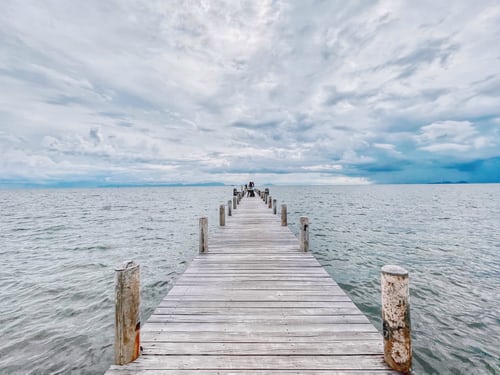
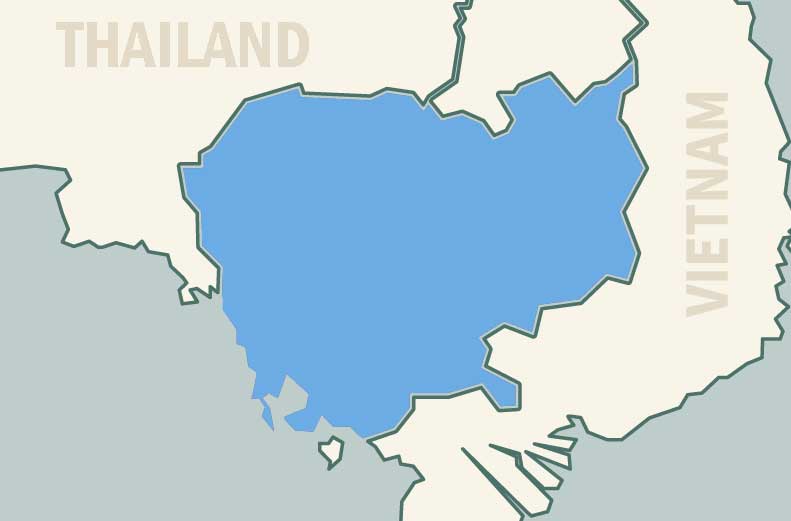
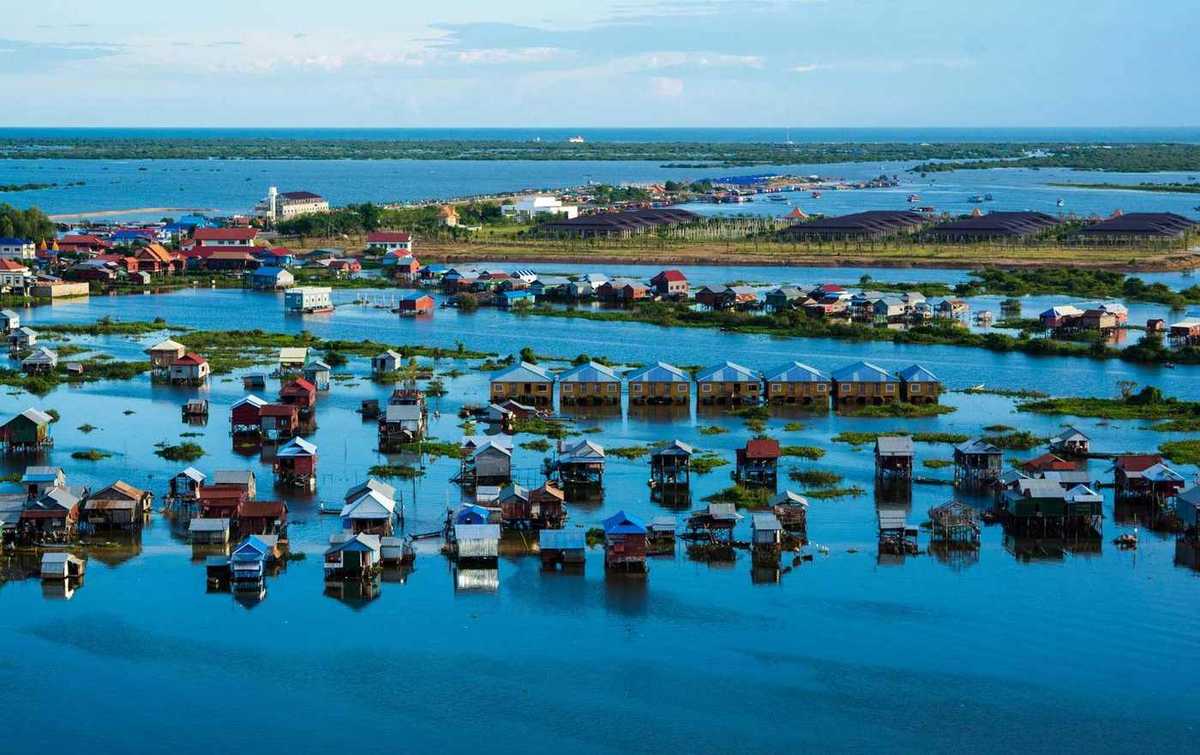
Cambodia meets Laos and Thailand along its northern edge, Vietnam on the east, and the Gulf of Thailand in the southwest. Inside those lines lie tropical rainforest and fertile farmland, cut through by rivers in every direction. Highland country rises in the northeast and again in the southeast. The capital stands where the Mekong, the Bassac and the Tonle Sap meet, the last of these draining a large inland lake of the same name at the heart of the country. Islands are scattered offshore along the southwestern coastline.
The climate is tropical, which means heat and humidity for most of the year. Rain arrives with the monsoon between May and November, and there is enough of it to keep a wide range of crops growing. Travel is easiest through the dry months, from November or December until April. Northern winters run cooler; elsewhere the thermometer barely moves. Flooding often reaches Phnom Penh and other regions through late July and into early August, and journeys can be delayed as a result. Otherwise there is little to fear: no volcanoes, no earthquakes, and tropical storms do not strike the country head on.
Buddhists of the Theravada school make up ninety-five percent of Cambodians, with small Muslim and Christian communities accounting for the rest. Practising any religion was banned in 1975; Buddhism regained national status in 1989.
Roughly 90 % of people in Cambodia are Khmer. Chinese, Vietnamese, Cham and highland communities, the Khmer Loeu among them, form the smaller groups, along with families of mixed descent. Khmer people have occupied the wider region since the 2nd century BC or thereabouts, most likely descended from Mongolian and Melanesian stock. India shaped the culture more than any other outside source, clear enough by the 2nd century AD. Hill tribes cluster today in the wooded uplands of the northeast. Once semi-nomadic, they farmed by slash and burn; rising numbers have since pushed them towards more intensive agriculture and towards the customs of the lowland Khmer.
Some 500,000 Cham descend from the Cham who put down roots in Central Vietnam during the 16th century, and they form the largest minority in the country. The Pol Pot regime singled them out and halved their number. Hindu at first, they later turned to Islam, and their spiritual centre sits at Chur-Changvra just outside Phnom Penh. Cattle trading, butchery and silk weaving are their traditional trades.
Chinese migration into the Khmer Kingdom came in waves through the 18th and 19th centuries. Later politics brought persecution and expulsion, and many fled; around 100,000 remain. Vietnamese residents number roughly 200,000, concentrated in the south of the country and in and around Phnom Penh.